Room II of XII
Romanesque
Thick walls, round arches and small deep windows: the first style shared across Western Europe since Rome, carried along pilgrimage roads and by monastic orders.
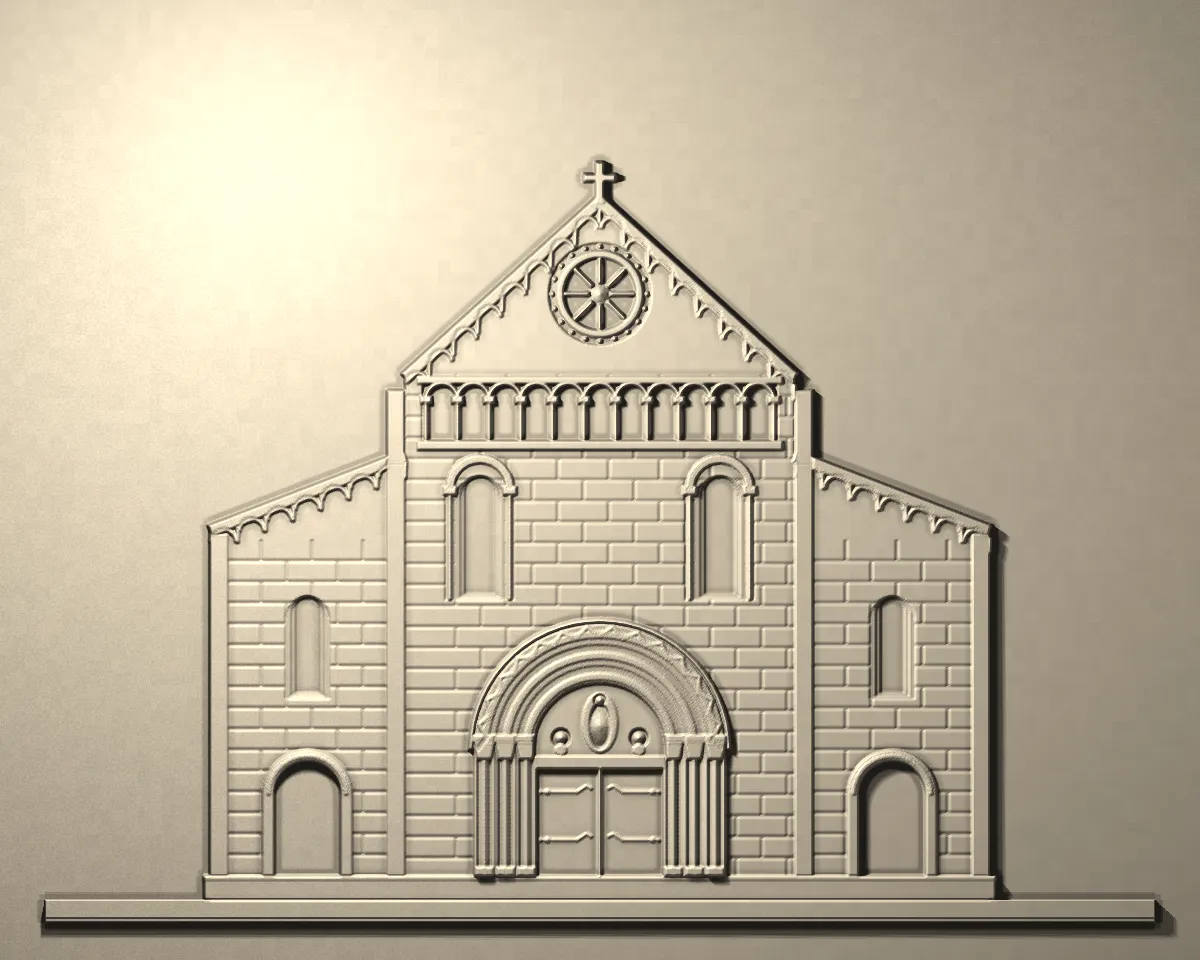
On this cast
How to spot it from the street
- Round arches over doors and windows
- Massive walls, small deep-set windows
- Little blind arcades under the eaves
- A carved tympanum over the main door
Where it came from
After the year 1000 Europe built churches in stone again on a huge scale. Without the Romans' concrete, masons relied on mass: thick walls carry heavy stone vaults, so windows stay small and set in deep splays. The round arch is everywhere, from portals to the little blind arcades under the eaves.
The name is modern. In 1818 the French antiquary Charles de Gerville called it 'roman' because it looked like a debased Roman architecture. Look at the portals: the doorway steps in through several round orders, and the half-moon tympanum above it was the medieval billboard, carved with Christ in judgement.
Famous Romanesque buildings

Pisa Cathedral
Pisa, Italy · 1063/64–1092 (consecrated 1118; façade 12th century) · Buscheto; façade by Rainaldo
The type example of Pisan Romanesque: white and grey marble, stacked open loggias on the façade.
Photo: Luca Aless, CC BY-SA 4.0, via Wikimedia Commons

Speyer Cathedral
Speyer, Germany · 1030–1061; vaulted under Henry IV after 1077 · commissioned by Emperor Conrad II
One of the largest Romanesque churches and among the first to be vaulted throughout; burial place of eight emperors and kings.
Photo: Friedrich Haag, CC BY-SA 4.0, via Wikimedia Commons

Durham Cathedral
Durham, United Kingdom · 1093–1133 · begun under Bishop William of St-Calais
Norman Romanesque with chevron-cut piers; its early ribbed vaults point the way to Gothic.
Photo: David Purchase, CC BY-SA 2.0, via Wikimedia Commons