Room X of XII
Brutalism
Raw concrete showing the grain of its timber moulds, heavy sculpted masses, and the same module repeated hundreds of times.
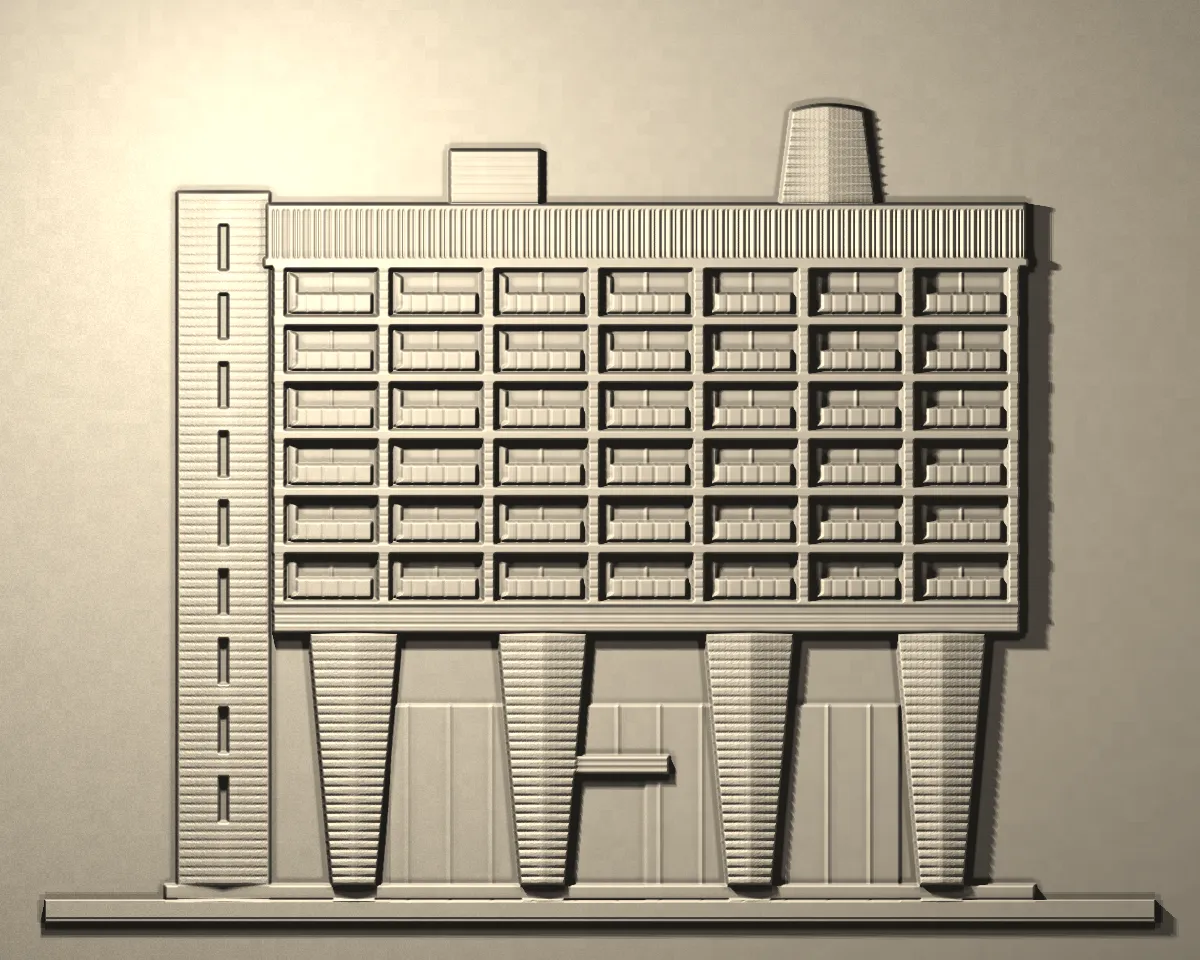
On this cast
How to spot it from the street
- Exposed raw concrete with board marks
- Heavy, blocky, sculptural masses
- Deep-set windows in a repeated grid
- Stair and service towers as separate volumes
Where it came from
Le Corbusier's Unité d'Habitation in Marseille (1947–52) left its concrete rough as it came out of the formwork: béton brut. In Britain Alison and Peter Smithson and the critic Reyner Banham turned that into 'the New Brutalism', an honest, tough architecture for the welfare state.
Brutalism was used for universities, housing estates, theatres and city halls from London to Boston to Tbilisi. Look for the board marks and tie holes in the concrete, deep-set windows in a repeated grid, and stairs and lift towers pulled out as separate sculptural volumes. It became the most hated style of its century, and is now being loved again.
Famous Brutalism buildings

Barbican Estate
London, United Kingdom · 1965–1976 · Chamberlin, Powell and Bon
About 2,000 homes, three towers and an arts centre on a WWII bomb site, linked by raised walkways.
Photo: Riodamascus, CC BY-SA 3.0, via Wikimedia Commons

Boston City Hall
Boston, United States · 1963–1968 (dedicated 1969) · Kallmann McKinnell & Knowles with Campbell, Aldrich & Nulty
Top-heavy concrete crown of offices over brick-paved public floors; a designated Boston Landmark.
Photo: ajay_suresh, CC BY 4.0, via Wikimedia Commons

National Theatre
London, United Kingdom · opened 1976–1977 · Sir Denys Lasdun (with Peter Softley)
Stacked concrete terraces and fly towers on the South Bank; board-marked concrete throughout.
Photo: Anthony O'Neil, CC BY-SA 2.0, via Wikimedia Commons