Room V of XII
Baroque
The same classical vocabulary, set in motion: curving walls, clustered columns, broken pediments and statues caught mid-gesture.
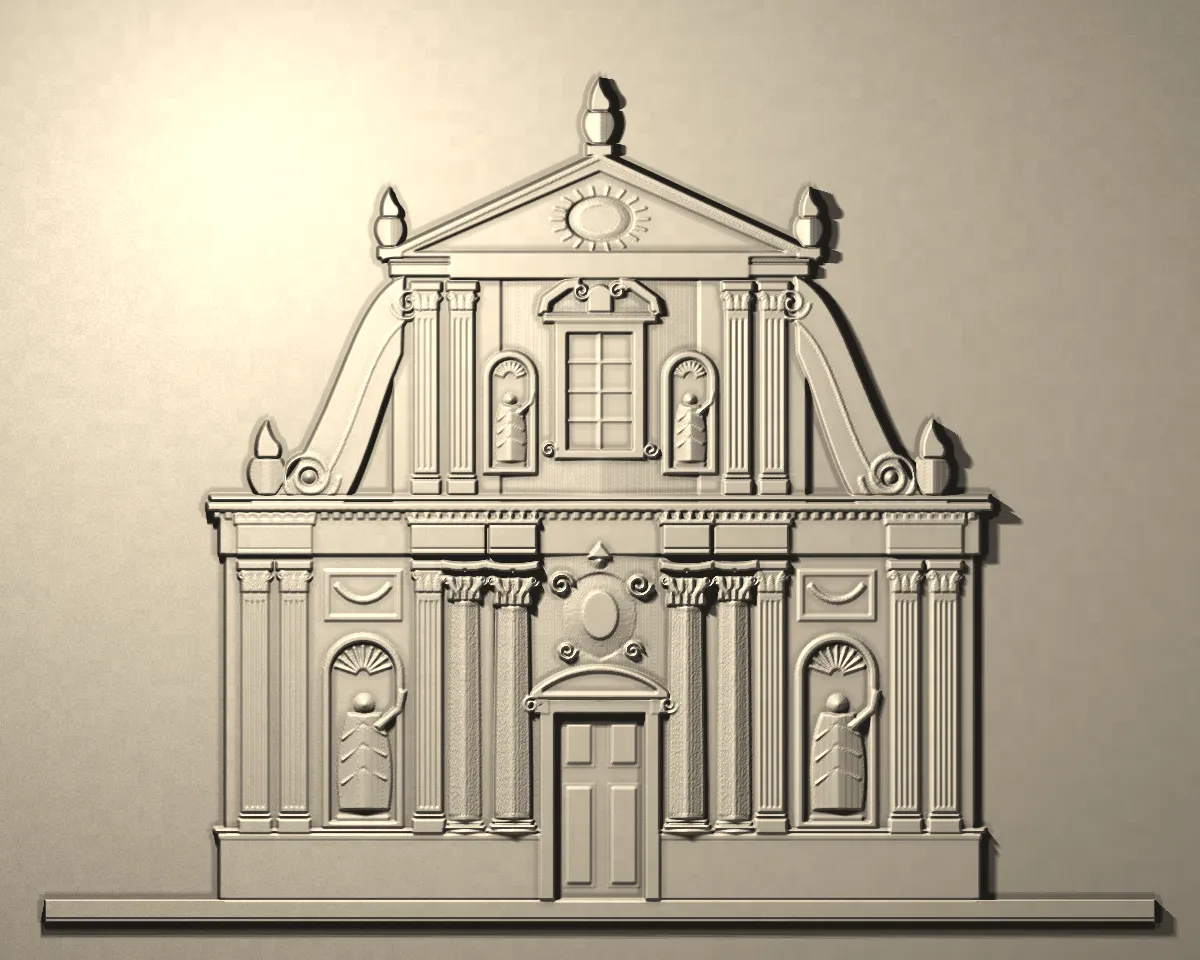
On this cast
How to spot it from the street
- Columns and pilasters bunch toward the centre
- Curving or bowed walls
- Big scrolls (volutes) and broken pediments
- Statues, cartouches and dramatic shadow
Where it came from
Baroque was born in Counter-Reformation Rome, where the Church wanted buildings that moved people. Giacomo della Porta's front of Il Gesù set the pattern of a wide lower storey joined to a narrow upper one by giant scrolls. Carlo Maderno's Santa Susanna (1603) piled up columns toward the door, and Bernini and Borromini made façades curve and ripple.
Read a Baroque front from the edges to the centre: flat pilasters, then half-columns, then full columns, as if the wall were swelling toward you. Cornices break forward over every column, pediments split and nest, and light and shadow do much of the work.
Famous Baroque buildings

San Carlo alle Quattro Fontane
Rome, Italy · designed from 1634; church c. 1638–1641; façade 1665–1667 · Francesco Borromini
Borromini's first independent commission; a tiny church with a rippling concave-convex façade and an oval dome.
Photo: Architas, CC BY-SA 4.0, via Wikimedia Commons

St Paul's Cathedral
London, United Kingdom · 1675–1710 · Sir Christopher Wren
English Baroque rebuilding after the Great Fire of 1666; twin west towers and a great dome.
Photo: Diliff, CC BY 2.5, via Wikimedia Commons

Karlskirche
Vienna, Austria · 1716–1737 · Johann Bernhard Fischer von Erlach, completed by Joseph Emanuel Fischer von Erlach
Votive church pledged by Emperor Charles VI after the plague of 1713; a temple portico flanked by two giant columns with spiral reliefs, under an oval dome.
Photo: Diego Delso, CC BY-SA 4.0, via Wikimedia Commons