Room XII of XII
High-Tech
The building as a machine: exposed steel structure, services piped outside in bright colours, glass skins and factory-made parts.
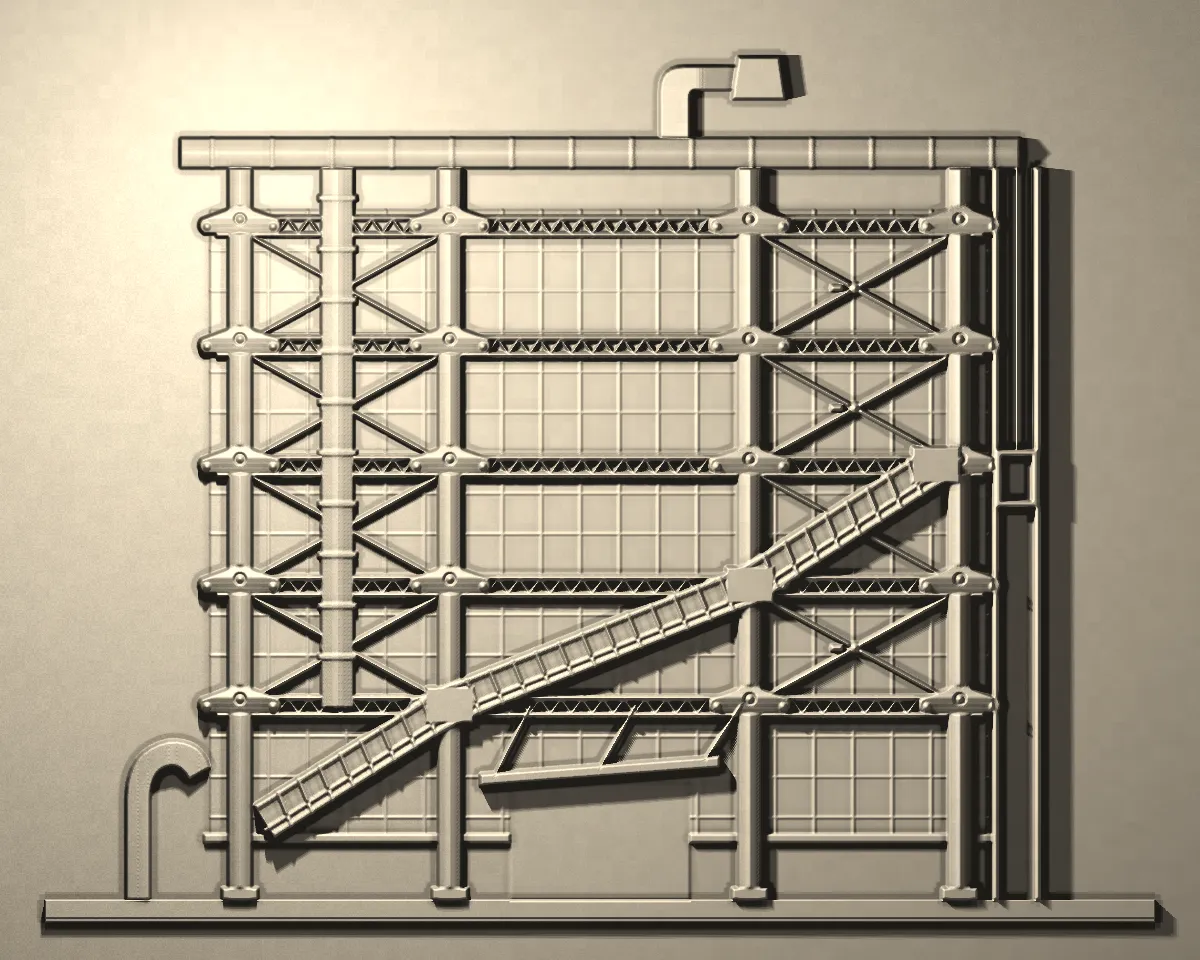
On this cast
How to spot it from the street
- Structure on the outside: columns, trusses, cross bracing
- Pipes, ducts and lifts on the façade
- Glass curtain walls
- Precise, factory-made joints
Where it came from
Richard Rogers and Renzo Piano's Centre Pompidou in Paris (1971–77) turned the building inside out: columns, bracing, escalators and colour-coded ducts all on the outside, so the floors inside are open and can change. Norman Foster's Sainsbury Centre (1978) and HSBC in Hong Kong (1986) and Rogers's Lloyd's building in London (1986) followed.
High-Tech celebrates how things are made and joined: cast nodes, tension rods, cross bracing, prefabricated panels. Its descendant is parametricism, a term coined by Patrik Schumacher in 2008 for the computer-generated, flowing forms of Zaha Hadid Architects and others.
Famous High-Tech buildings

Centre Pompidou
Paris, France · 1971–1977 · Renzo Piano, Richard Rogers and Gianfranco Franchini
Opened 31 January 1977; a 'cultural machine' with all structure and services on the outside. Closed for renovation from 2025, reopening planned for 2030.
Photo: Oliver Romo Miranda, CC BY-SA 3.0, via Wikimedia Commons

Lloyd's building
London, United Kingdom · completed 1986 · Richard Rogers (Richard Rogers Partnership)
The 'Inside-Out Building': stair and lift towers on the outside; Grade I listed in 2011, the youngest building ever to get that status.
Photo: Txllxt TxllxT, CC BY-SA 4.0, via Wikimedia Commons

HSBC Main Building
Hong Kong, China · 1981–1985 (designed from 1978; opened 1986) · Norman Foster (Foster Associates)
A steel structure with the floors suspended from trusses, leaving an open public plaza underneath; engineers Ove Arup & Partners.
Photo: 鄒延, CC BY-SA 4.0, via Wikimedia Commons